Alex Puhak, MS in Mechanical Engineering
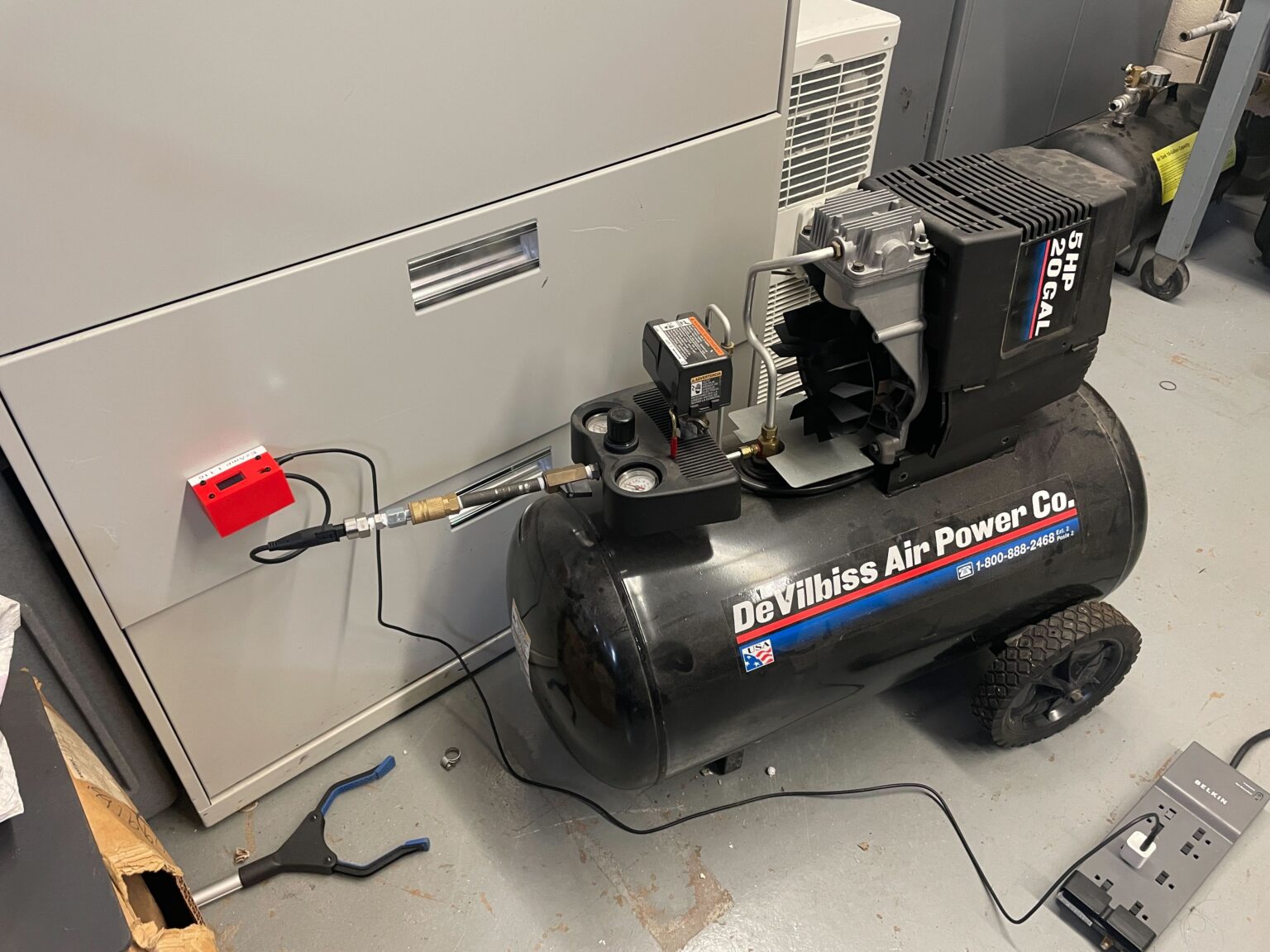
Compressed air systems, which pressurize air to store energy, comprise 10% of industrial energy usage in the United States. However, these systems are very inefficient due to issues such as leaks and heat losses. Research is now focused on developing tools to track mechanical and operational efficiencies. The focus will eventually shift focus to inefficiency tracking, such as leak detection and sequencing of compressors to address increasing loads. Currently, a sensor is being developed to track flow rate through a compressor.
Jaylen Patel, MEng
This research focuses on the development of a low-cost, non-invasive “OnOff” vibration sensor to address the difficulty of accurately tracking machine duty cycles during one-day ITAC assessments, replacing expensive current transducers and inaccurate operator estimates. The device utilizes an ESP32 microcontroller and an MPU6050 accelerometer encased in a 3D-printed shell along with magnets to allow for rapid, safe deployment directly onto industrial machinery. Following a successful pilot study that validated the sensor against ground-truth electrical data, the ultimate goal of this project is to provide ITAC centers nationwide with accessible, cost-effective datalogging tools to improve energy accounting during industrial assessments.
Chintan Lakhani, MS in Mechanical Engineering
The research is on compressed air systems by using continuous data monitoring through IOT devices to obtain the data and process which is useful assessing the compressed air system for leak detection, losses in pipe and for performance study. The data can be also used for predictive maintenance and fault detection.
Eslam Al Qawasmeh, MS in Mechanical Engineering
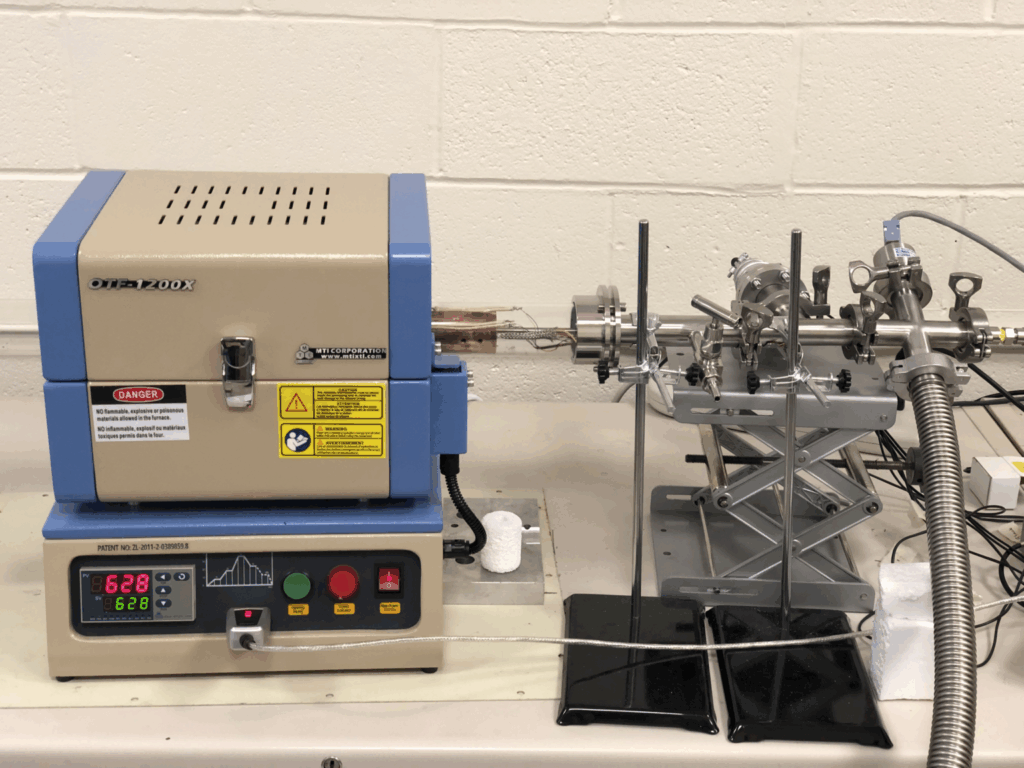
Calorimetry of an exothermic reaction is a current of great interest, but requires a high-resolution heat flow measurement. In this work, a fabrication of microwatt resolution ultra-high temperature differential calorimeter studies the heat flow measurement of the reaction between hydrogen and metal hydride. Hydrogen can be stored in different ways; this study focuses on solid-state storage using metal hydride.
David Garner, MS in Mechanical Engineering
This research optimizes latent heat thermal energy storage (LHTES) using triply periodic minimal surface lattices via additive manufacturing. It characterizes the effects of lattice type, density, storage volume, and heat transfer fluid speed on LHTES efficiency. Additionally, it compares LHTES with other energy storage methods based on power output, charge/discharge rates, energy storage density, applications, and limitations. The aim is to enhance LHTES performance and broaden its applicability in energy storage systems.
Aditya Mairal, PhD Candidate
Smart retrofitting can include automation, simulation, data collection and optimization of manufacturing processes. It is strongly coupled with the concept of Industrial Internet of Things (IIoT). The adoption of smart retrofitting in manufacturing is found to be modest despite their benefits. Lack of structured value proposition approach by application is suspected as one of the major reasons for lower adoption. In this topic we develop the value proposition matrix and apply the same to ten low-hanging fruit smart retrofit applications. This would provide a framework for understanding the full value a smart retrofit applications can provide. The matrix can also be used to rank the smart retrofit solutions. The value proposition matrix will further be quantified for the use cases by collecting the data through smart IIoT data collection devices.
Kelly Baber, MS in Mechanical Engineering
Blockchain technology’s fully reliable hierarchical ledger capabilities makes it a perfect candidate for alternative technology applications outside of its traditional cryptocurrency use. Here at CAES we are looking into specific use cases for blockchain. More specifically, if the Rutgers microgrid – which includes a roughly 28MW Busch Campus load, a 15MW Cogeneration Plant and 9MW of solar panels – were to act as an island-able, presuming microgrid and sell excess generation. An economic opportunity cost-benefits analysis is being performed as well as how the promotion of renewable energy could increase the value of our green energy. A secondary focus is to calculate and derive the pedigree classification factors which include efficiency, emissions, loss of attributes, reliability and a few other factors of our Rutgers CHP plant. We are hopeful in finding relations that can give us a new pricing model for excess energy to be sold to other plants or back to the grid.

Christopher Murphy, MEng in Energy Systems
A combination of research and IAC program quality assurance regarding photovoltaic recommendations. 15-minute data, otherwise known as interval data, is of particular interest. Figuring out the best way to line up interval data from a plant’s electrical usage with photovoltaic generation provides the most realistic results but is not always possible. Softwares such as PVWatts and NREL’s SAM have been investigated. This research is all about understanding the benefits and drawbacks of current practices in an attempt to figure out the best practice.
Subhash Kungumaraj, MS in Mechanical Engineering
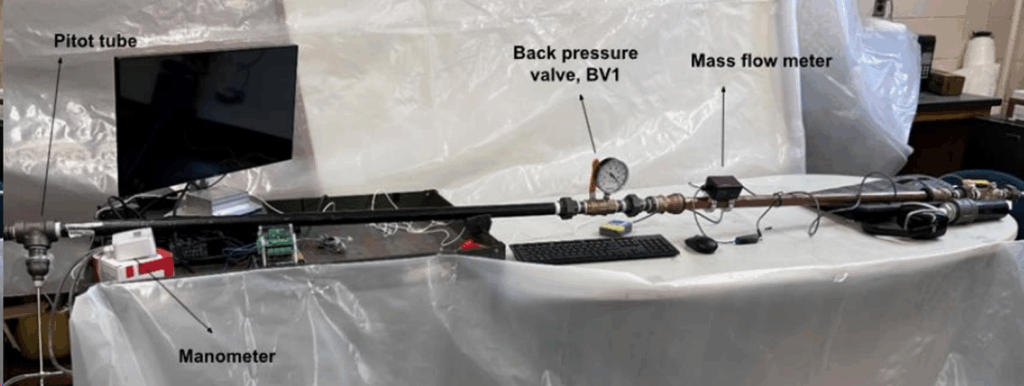
This research studies the role of flow meters in industrial compressed air systems and develop a facility for mass flow meter evaluation. Flow meter placement was studied with respect to different system layouts. Ideal placement was determined based on type of layout and location of equipment. This also enabled baselining performance and helping maintain overall system operation. Flowmeters downstream of every compressor gives individual and total compressed air generation. On the demand side, a multiple loop and trunk layout with only one compressed air line from the main loop is a good layout design for flowmeter placement and compressed air delivery.practice.
Eslam Al Qawasmeh, Graduate Student
The 2023 Distributed Wind Conference (DWEA) took place from February 27th to March 1st 2023 in Washington, DC. This conference is for leaders of the distributed and community wind industry to showcase their sector of the wind industry to an audience of policy makers, agency staff, and renewable energy industry leaders to promote new business opportunities and relationships as well as gain insight into potential new markets. Eslam Al Qawasmeh, David Garner, Evan Bickel, and Dr. Todd Rossi from Rutgers Center for Advanced Energy Systems (CAES) attended the DWEA Conference as part of the REpowering Schools’ (REpS) National Small Wind Turbine Research Project sponsored by FedEx. During the fall semester of 2022, Dr. Todd Rossi merged the research project with the Rutgers mechanical engineering alternative energy course in which 55 senior undergraduate students were introduced to solar, wind and other renewable energy sources; they received hands-on, experiential learning on the fundamentals of wind turbine testing, evaluation, and validation with the small wind turbine donated by REpS. Additionally, CAES will
continue to test the wind turbine in a hybrid wind-solar energy system. At the DWEA Conference, the CAES team presented on the turbine research conducted along with 5 other universities who were part of the REpS program. Students had the chance to network with industry professionals and discuss career opportunities and professional guidance.
Through functionalization of a thermally conductive, hydrophilic solid substrate’s surface, by dual micro and nano scale roughening and reduction of surface energy to induce superhydrophobicity, the rate of condensate production and heat transfer is modified for dropwise condensation on the cooled surface, when condensate is continuously removed from the condensing surface.
Fluidized beds have enormous potential to improve environmental performance of coal combustion. At CAES, we have studied a wide range of topics related to fluidized bed performance optimization including minimization of temperature fluctuations and the effects of vibration on the system. In addition, we primarily focused on mixing in fluidized beds and breaking up large agglomerates. Designing the size and shape of these objects requires accurate modelling of drag and buoyancy effects, and development of an understanding of the “unfluidized hood” which appears on top of any large submerged object.
SMART Manufacturing is an emerging field that uses sensors to connect industrial machinery within a manufacturing plant to the internet for the purposes of data analytics and remote status monitoring. CAES is working to develop a process and protocol for identifying and recommending SMART projects to manufacturers within the Industrial Assessment Center Program, including questions to ask plant personnel, observations to make during the plant tour, and measurements to take throughout the day. Currently, CAES is studying the applications of the ABB Smart Sensor – a non-invasive instrument that relays the physical data of a traditional motor to the user via bluetooth technology. The sensor’s capacity for short-term data collection and the modeling potential of said data is being investigated.
Sara Neiss, Graduate Student
Hydropower is a relatively old technology, but Wave Energy Converters (WECs) are an emerging industry, experiencing rapid expansion in the last 5 years and are currently positioned where wind was about 8 years ago. In the field of marine energy capture, they represent a safer, simpler, and more economic alternative to tidal and offshore wind energy. While wind farms are a more mature technology and industry than current WECs, energy provided by ocean waves is denser, more consistent, and more predictable than wind, holding greater earning potential. Furthermore, WECs provide significant ancillary benefits to nearby marine structures, especially wind farms. CAES is conducting research into the optimization of Wave Farm designs co-located and sharing infrastructure with offshore wind to produce the greatest economic yields from power generation per square foot as well as stimulate further development in the Wave and Wind Farm industries.
Joshua DeVenezia, Graduate Student
The US Energy Information Administration (eia.gov) estimates that demand charges in the commercial sector account for 30 to 70 percent of monthly electric bills, although rates vary considerably by utility, location, season, and building type. One proposed way to curtail high demand charges is by programmatically scheduling flexible loads to even out power consumption over the demand-setting window. The research at Rutgers’ CAES is focused on developing and testing a demand limiting Model Predictive Control (MPC) algorithm for unitary HVAC systems called Unit Coordination (UC). The application coordinates flexible rooftop unit (RTU) loads to avoid coincident runtimes. The MPC algorithm is designed to toggle RTU operation by setting an optimal demand ceiling that forces the zones to “take turns” when flexibility is present. The optimizer can be configured and implemented using only the onsite thermostats, where control decisions are relayed to the thermostats via API as setpoint adjustments that turn units on or off. No physical setup needed. The research explores the scope of viable MPC use cases in Building Energy Management and seeks to uncover real world technical challenges and algorithm deficiencies.